

Mark your Calendars!! Eco Fair Sunday November 15 after the Service
The Ministry for the Earth Committee is hosting an Eco Fair on Sun Nov 15 and will be inviting local businesses that support sustainability and a greener way of living to table after the Service – for example: Habitat for Humanity, Scrappy Elephant, the Refill Store. Please let us know If you have any suggestions as to who to invite.
UUMFE Community Read: Radically Reframing Climate Change
The UU Ministry For Earth is hosting a community read of the new book “ Radically Reframing Climate Change: A Guide to Changing Ourselves ’ by Will Hackman Hackman argues that the problem isn’t scientific or fact-based, but rather political, emotional, and ideological. He identifies three leading barriers to solving climate change: polarization, paralysis, and inadequate messaging. Framing the climate crisis as a humanity crisis, Hackman encourages readers to convert their anxiety and anger into action. We will meet on the fourth Monday of every month beginning September 28 7:45pm. I have purchased the book (only 200 pages!) and plan to participate; hope you will join me. Community Read
Cville City Residents: E-bike Voucher Applications are Open!
Charlottesville’s E-bike Voucher Program is back and signing up has never been easier. Go to Connect Charlottesville to enter your name into the drawing to win a voucher for the purchase of your very own e-bike. Sign-ups will be accepted now until Thursday, October 1st.
Virginia Department of Forestry wants your acorns
 The Virginia Department of Forestry is asking for help collecting acorns and walnuts to repopulate our forests. “Our annual acorn collection campaign is not only a fun way for Virginians to engage in forestry, conservation and dendrology, but is a huge help to DOF,” said Augusta Nursery Manager Joshua McLaughlin. “Thanks to these donated acorns and nuts, we can plant and grow healthier trees that are already suited to Virginia’s climate. Plus, this helps the agency financially… the more donations we receive, the less we spend to purchase seed. DOF then redirects those savings to improve other aspects of nursery operations.
Directions: Collect – Place in a paper bag or box (no plastic!) Please keep acorns and nuts separated by species. If you’re unsure, include a leaf from the tree with the acorns. Identify – Mark the bag/box with the date, species and location (e.g.; Oct. 11, White Oak, Roanoke). Drop – Deliver to your closest collection site. (900 Natural Resources Drive, Cville) Donation Deadline: Oct. 11, 2026. Read More Here
Week Without Driving: October 1-8
Join us in a Week Without Driving experience to learn more about the barriers and challenges that nondrivers face in our community, to reflect on the challenges you would face as a full-time non-driver, and to consider how you can advocate for a regional transportation system that supports both drivers and non-drivers. Here’s how the national organization describes #WeekWithoutDriving from a the perspective of a long-term non-driver:
If you can drive or afford a car, you may not understand what it’s like to rely on walking, rolling, transit, and asking for rides. But for nearly a third of people living in the United States – people with disabilities, young people, seniors and people who can’t afford cars or gas – this is our every day. We created the Week Without Driving experience so that those who have the option to drive can learn firsthand about the barriers and challenges that nondrivers face and work with nondrivers to create more accessible communities for all. Week Without Driving
Keep the Roadless Rule in Place! Repeal of the Roadless Rule Threatens 84% of Virginia’s Wildest Public Lands
The U.S. Forest Service has proposed rolling back the 2001 Roadless Area Conservation Rule, which currently protects some of our most precious national forest areas from road construction and logging. Rescinding this rule would open up these protected areas to deforestation and other destructive impacts. Appalachia is particularly susceptible to flooding. Our trees slow the flow of water during heavy rains, holding the soil in place, preventing erosion and allowing more water to be absorbed by the soil and vegetation. Evidence shows that past deforestation of areas for mining and logging significantly contributes to the severity of flooding in the region.
Sign the Appalachian Voices petition here: Roadless or Southern Environmental L aw Center’s petition here: SELC
Priceless to me’: Valley Link transmission line threatens generational farm in Orange County
Michael Carter plans to leave behind his family’s century-old farm if the energy project is approved. It started November 5th, 1910. My great-great-grandparents purchased this property for $722.50,” Michael Carter Jr. said at a picnic table outside the Orange County home where generations of his family have been born and died. While the final route preferred by the company is yet to be determined, all three of the current iterations of the route all converge on this spot bordering Carter’s family’s land. The line will send surges of power to Northern Virginia, where most of the state’s data centers are clustered. Virginia Mercury: Priceless to me
Data Centers Are Driving an Alarming Gas Power Expansion in the US
There’s no clearer sign of the data center boom than rampant gas projects that have been proposed or that are already under construction. The US now has 3x the amount of gas power as China, thanks to data centers. In the first half of 2026 alone, the gas-fired capacity under development for data centers in the U.S. nearly doubled, according to Global Energy Monitor, a research nonprofit that tracks energy infrastructure.A third of that project pipeline is in Texas alone, where 122 GW of gas-fired capacity is in development—more than many entire countries are planning. Fast Company: Gas Power
I recently signed up for Go Green Post Newsletter and will be sharing tips from it.
In addition to the newsletter, the editor ** is working on a book; here is an interesting excerpt from it. Have you ever wondered what people did before plastic? It started as a question I thought about a lot and got from readers: what did people do before plastic? The first deodorant- Odorono- came in a glass bottle. But as demand exploded through the mid-20th century, packaging followed the same pattern as almost every other personal care product. It went plastic. Plastic was cheap, lightweight, and easy to manufacture at scale. Like most packaging decisions of that era, nobody was thinking about where it would end up. The good news is today we have alternatives. Plastic-free deodorants in cardboard tubes, refillable metal cases, and compostable packaging are now available, while the natural deodorant within them that didn’t work as well in the past has largely been solved by modern formulations. ** I’m Logan, a sustainability professional and founder of The Go Green Post and a separate sustainability consulting company.
Logan asks: What’s one sustainability topic you ‘d love to learn more about? I read every response, and many future issues are inspired directly by reader suggestions. Note from Ellie: let me know if you have one!
New Riparian Buffer Protection Standards Take Effect September 1
H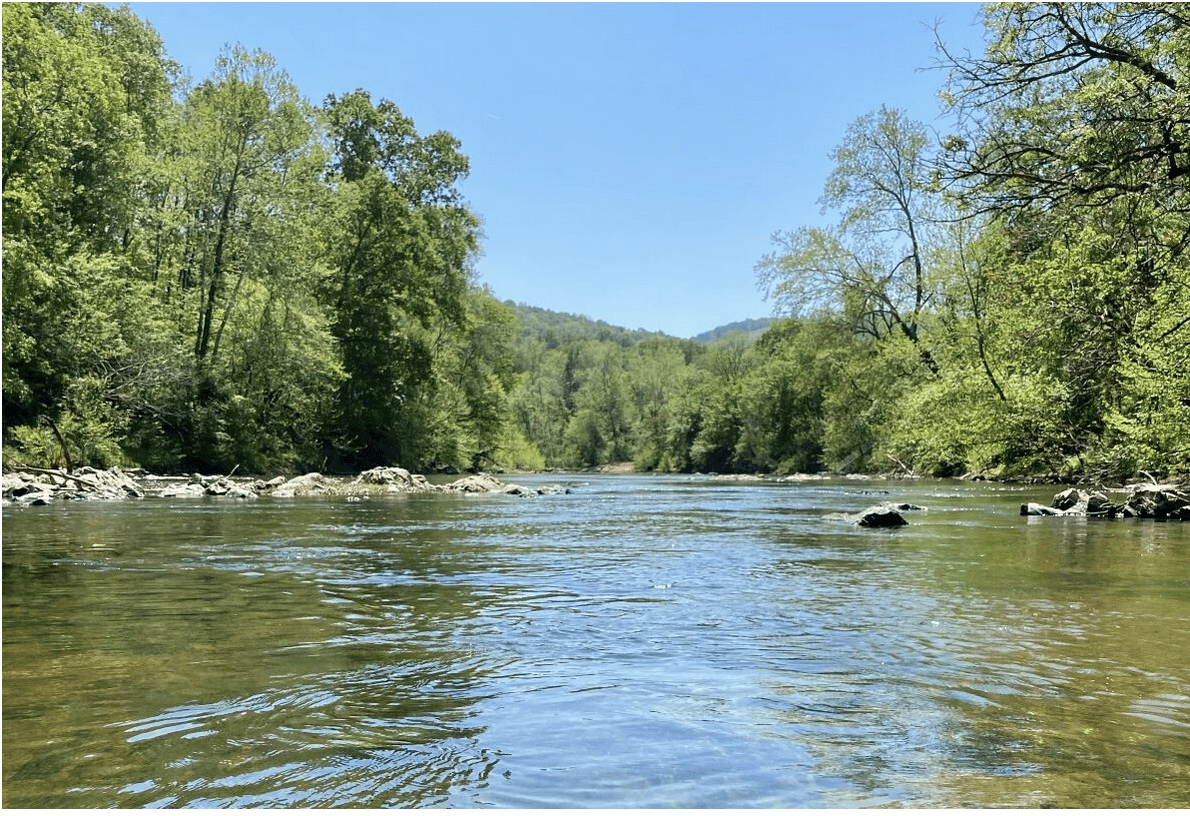 ealthy stream buffers help protect water quality, prevent erosion, and provide habitat for fish and other aquatic life. Beginning September 1, Albemarle County’s updated Riparian Buffer Protection Standards will take effect. The Board of Supervisors adopted the updated standards on June 17 as part of the County’s Stream Health Initiative. The standards strengthen protections for vegetation along streams and rivers and align County regulations with Virginia’s Chesapeake Bay Preservation Act.
What Is a Riparian Buffer? A riparian buffer is an area of vegetated land next to a stream, reservoir, wetland, or pond. Trees, shrubs, and other vegetation within these areas help: Albemarle Community Development Department: Riparian
Department of Environmental Quality’s groundwater report: Va. must budget to live within environmental limits
 DEQ’s report crystalizes that our environment is finite and that we must take care not to damage our aquifer’s ability to store water in the future and risk contaminating drinking water supplies with saltwater intrusion, guest columnist Eric Bonds writes. The timing of the release of the Virginia Department of Environmental Quality’s report on groundwater availability last month was suspicious, given that it was completed in January but not made available to lawmakers or the public until several months after the General Assembly’s legislative session. The science presented in the report is impressive, while its findings are alarming. Most of the attention it has received relates to data centers, but they weren’t the report’s main focus. It’s really about the importance of living within environmental limits. This lesson applies both to water and energy use. First for the shocking news: Just one industry – and two individual plants – have disproportionate responsibility for groundwater depletion in eastern Virginia – and its not data centers!!! Virginia Mercury: Water Budget
Mamdani, Hochul announce $8.4 million initiative to transform concrete medians into green infrastructure across Queens
Mayor Mamdani and Gov. Hochul have announced a new $8.4 million initiative to create flood resiliency infrastructure across Queens by converting concrete roadway medians into green infrastructure “sponges” that can absorb excess stormwater and help prevent extreme flooding. Mamdani said the new infrastructure would help the neighborhoods deal with “more intense and unpredictable bursts of rain” brought on by climate change. The transformed medians, which will be located in Whitestone, Forest Hills and Queens Village, will capture an estimated five million gallons of stormwater each year, alleviating pressure on local sewage systems. The initiative also aims to improve the quality of local waterways, including the East River, Flushing Bay and Jamaica Bay. QNS: Medians
Amazon changes course on water use for King George data center campus
Amazon Web Services is changing course on how a King George data center project will get its water after an application to renew a groundwater permit allowing withdrawals of up to 6.4 million gallons annually from the Potomac aquifer raised concerns.The tech giant is set to construct a major data center campus in the county at the Birchwood Drive tech campus that could host more than a dozen data centers across the 869-acre property. While some of the project is currently tied up in court proceedings, an application to renew a water permit already in place for the tech campus led Sen. Richard Stuart, R-King George, to urge the Department of Environmental Quality to deny the application. Virginia Mercury: Amazon
New York City Announces Release of First-Ever Urban Forest Plan (UFP)
The plan lays out NYC’s strategy to achieve 30% tree canopy by 2040 through protection, preservation, and planting of more trees. Chief Climate Officer Louise Yeung announced the release of New York City’s first-ever Urban Forest Plan (UFP): a comprehensive roadmap to preserve tree canopy, plant more trees, and cultivate an ecosystem of stewardship. Today, the urban forest canopy shades 23.4% of New York City, covering roughly 45,000 acres — an area about the size of Brooklyn. Reaching this expanded canopy will help the City achieve broader goals of advancing environmental justice, mitigating the effects of heat, and improving quality of life. NYC Mayor’s Office of Climate & Environmental Justice: Urban Forect
Spanberger spearheads first-in-nation clean energy savings program
The biggest news of Spanberger’s work for affordable energy came on July 13, when she announced Virginia will be the first state in the nation to offer a statewide group-purchasing solar initiative. The program, Switch Together, will lower costs for households making the change to solar energy. Switch Together is a partnership between Spanberger’s office and Solar United Neighbors (SUN), a nonprofit organization based in Washington, DC. It helps address her energy affordability messaging and plan by offering residents a way to reduce their energy bills by going solar but doing so below market rate at a much discounted price. Office of the Governor of Virginia: Energy Affordability Initiative
New proposal from grid operator PJM would require data centers to bring their own power
PJM, the regional grid operator for most of the East Coast, is asking federal regulators to approve a rule requiring new large-load customers, namely data centers, to bring their own power supply to the grid. With Virginia among the 13 states served by PJM, the proposal filed with the Federal Energy Regulatory Commission could mean further changes to how the state regulates the growing industry. It follows calls from some Virginia lawmakers to make data centers provide their own power as utility bills continue to rise alongside demand. Part of the new proposed rule would put data centers that have not “brought their own power” by paying directly for new energy capacity or having their capacity needs covered through backstop power purchases first in line to be moved onto back up generators or asked to reduce their loads on the hottest and coldest days of the year, when the grid is strained. Virginia Mercury: PJM
How 1 mile of fencing became a wildlife crossing success story in Virginia
Virginia sees higher rates of wildlife-vehicle collisions than many states. In fact, Virginia is in the top ten according to State Farm Insurance. In 2025, the general risk of a motor vehicle collision with deer, elk or moose across the U.S. was 1 in 139. In Virginia, your risk was 1 in 82. In 2015, researchers advised the Commonwealth to construct fences around two existing wildlife crossings near Afton Mountain on I-64, outside Charlottesville. The following year, Virginia enclosed both crossings with one mile of 8 ft tall fencing. Adding fencing protects wildlife from oncoming traffic, ensuring wildlife reach the box culvert and bridge underpass. Cameras posted at each crossing demonstrate these fences were wildly successful. Environment America: Fencing
Progress on permitting reform:
A bipartisan pair of representatives just introduced a new House bill to streamline the approval of interstate transmission projects. The bill is called the CLEAR Act, led by Reps. Scott Peters (D-CA-50) and Gabe Evans (R-CO-8). It’s great to see this bill enter the conversation, because transmission is one of the critical pieces needed to ensure that permitting reform reduces emissions in a major way.
For the planet ,
Ellie Syverud